
Why Large Vehicle Storage Facilities Are Investing in Hail Net Protection Canopies
For organisations responsible for storing hundreds or even thousands of vehicles, severe weather has always been a risk. Today, that risk is becoming increasingly difficult to ignore.
A major hail storm can damage millions of dollars worth of vehicle inventory in a matter of minutes. Beyond the immediate repair costs, businesses can face disrupted operations, delayed deliveries, insurance claims, increased premiums and reduced margins. As weather events become less predictable and more severe, hail protection infrastructure is increasingly being recognised as a long-term investment in business resilience. For many organisations, protecting vehicle inventory is no longer simply about avoiding damage. It is about protecting profitability, operational continuity and long-term business performance.
Weather Risk Is Becoming a Financial Risk
For many organisations, the business case for hail protection extends well beyond protecting physical assets.
According to the Insurance Council of Australia, insurers have paid an average of approximately $2.1 billion per year in extreme weather claims over the past 30 years. Over the most recent five-year period, that figure has more than doubled to approximately $4.5 billion annually, highlighting the growing financial impact of extreme weather across Australia.
The Insurance Council of Australia also reported that four major weather events during the 2023-24 catastrophe season resulted in almost 157,000 insurance claims and $2.2 billion in insured losses.
More recently, severe hailstorms across Queensland and New South Wales generated more than $1.4 billion in insured losses during 2025. While insurance remains critical, many organisations recognise that insurance alone does not prevent operational disruption, vehicle downtime, administration costs or customer impacts.
The growing cost of extreme weather is changing how many organisations approach protecting vehicle inventory. What was once viewed as an operational consideration is increasingly becoming a strategic investment in risk management and business resilience.
Investing in Certainty
While no organisation can control the weather, they can reduce their exposure to risk. Rather than reacting to severe weather after the event, organisations are investing in solutions that assist with protecting vehicle inventory, reducing operational disruption and creating greater certainty around future business costs.. For many decision-makers, the question is no longer what a hail protection canopy will cost, but what a single major hail event could cost the business.
Why Hail Protection Infrastructure Is Growing in Importance
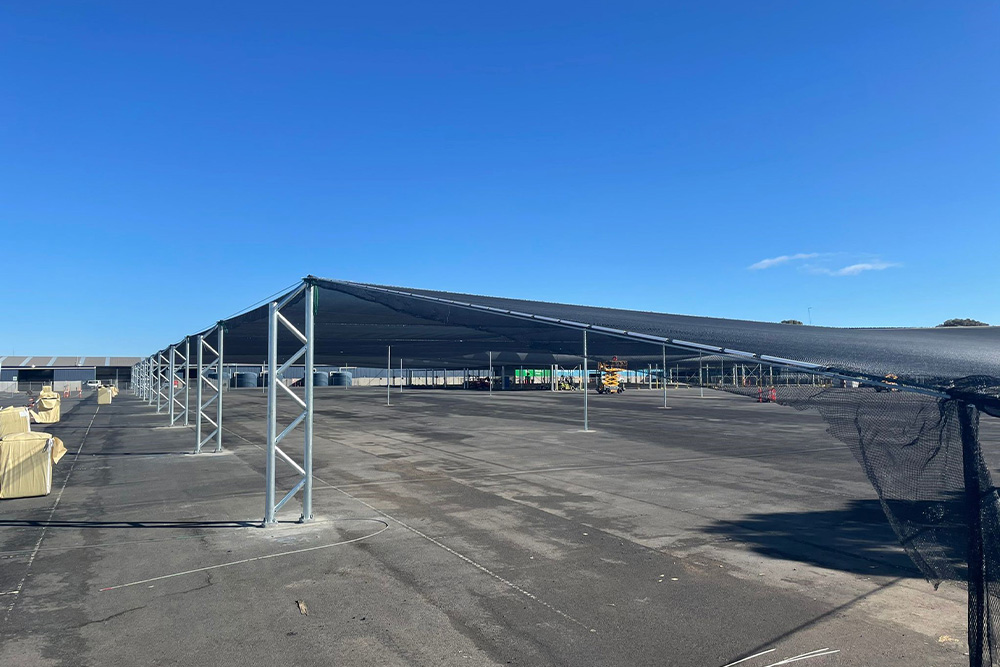
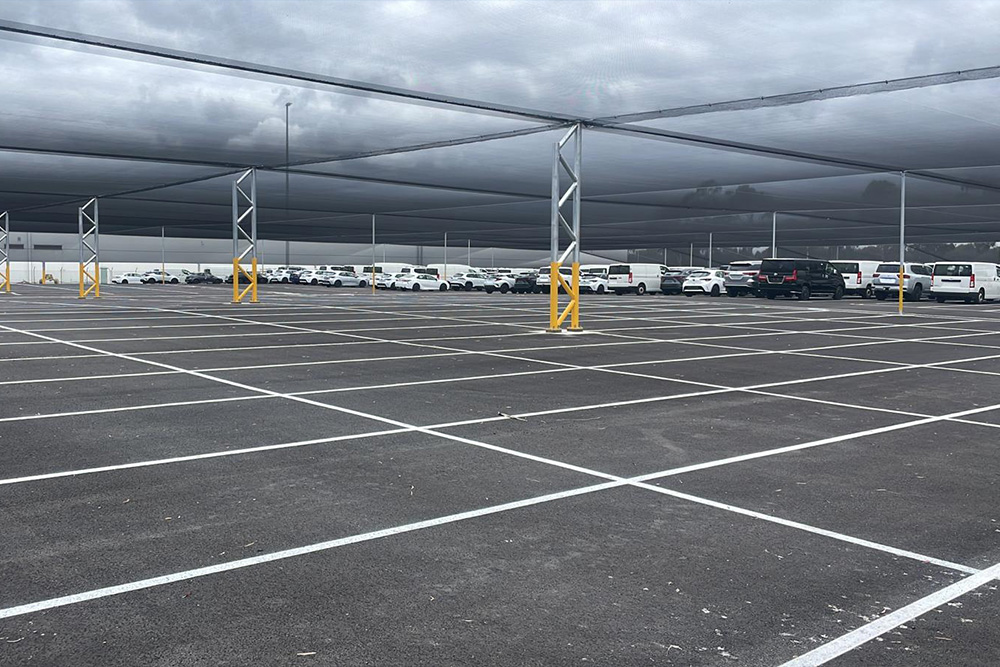
Purpose-designed hail protection systems such as MakMax Australia’s TensoNet Hail Net Protection Canopy use lightweight cable-supported structures and specialised netting materials to create large protective canopies over vehicle storage areas. The result is a practical, scalable solution that protects valuable inventory while maintaining operational flexibility.
One of the key reasons TensoNet has been adopted by vehicle storage operators is its ability to cover very large areas efficiently. MakMax has delivered TensoNet projects spanning up to 80,000 square metres. As project size increases, cost efficiency often improves, making the system particularly attractive for large-scale vehicle storage facilities. This scalability makes TensoNet particularly well suited to organisations responsible for protecting vehicle inventory across large automotive compounds, processing centres and fleet storage facilities.
Protecting Assets When It Matters Most
The purpose of a hail protection canopy is simple: safeguard the assets below. During severe weather events, the netting system absorbs the impact energy of hailstones before they can strike vehicles directly. The netting is designed as a sacrificial component focused on protecting the more valuable assets below. Following an extreme weather event, netting may require inspection, re-tensioning or replacement, while the primary structure remains a long-term asset.
Engineering for Resilience
When structures cover many hectares of vehicle storage, resilience becomes every bit as important as protection.
Large TensoNet installations incorporate reinforced structural zones known as Redundancy Bays. These strategically positioned reinforced internal columns provide additional strength and compartmentalisation throughout the canopy system. Should a catastophic event occur, such as an extreme weather incident or accidental vehicle impact, redundancy bays help limit the extent of any localised damage and protect the integrity of the wider structure. This detail-oriented engineering approach provides confidence for operators managing high-value vehicle inventories.
Supporting Active Operations 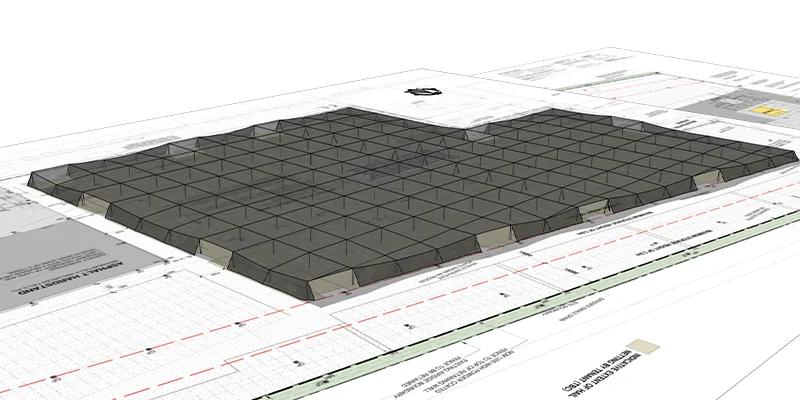
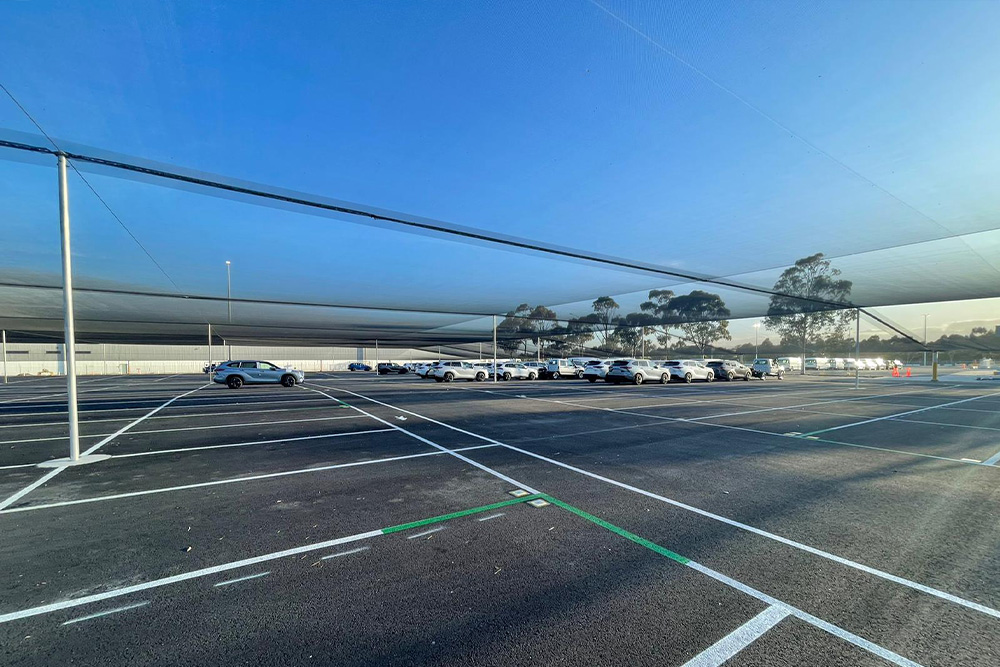
TensoNet is typically engineered as a free-standing structure, allowing support columns to be positioned in a manner that maximises vehicle storage capacity while maintaining drive aisles, site entrances and exits, and overall operational functionality.
Generally configured on a square grid layout, the system can be adapted to accommodate non-parallel boundaries, irregular site geometries and other site constraints. This flexibility enables coverage to be optimised across the entire facility, regardless of the shape or configuration of the lot.
The system can also be installed in carefully planned stages, allowing active sites to continue operating throughout construction. For busy logistics hubs, auction facilities and vehicle processing centres, minimising downtime is often as important as the protection outcome itself.
Long-Term Infrastructure with Low Maintenance Requirements
As organisations increasingly focus on lifecycle value, infrastructure decisions are moving beyond initial capital cost alone.
Routine maintenance for a TensoNet system typically involves scheduled inspections of the netting, cable systems and structural components. The primary steelwork and cable infrastructure are engineered as long-term assets, while the netting itself can be repaired or replaced independently as required.
This approach allows owners to maintain performance over time while extending the useful life of the overall structure.
Proven Across Australia’s Automotive Sector
MakMax has delivered TensoNet hail protection projects for leading automotive and vehicle storage operators throughout Australia.
The Altona TensoNet Hail Net Protection Canopy, Manheim Auctions Melbourne TensoNet, and Manheim Auctions Brisbane TensoNet projects demonstrate how large-scale hail protection infrastructure can be successfully integrated into busy operational environments.
These projects demonstrate a growing trend across the automotive sector, with operators investing in infrastructure specifically designed for protecting vehicle inventory in increasingly unpredictable weather conditions.
Investing in Long-Term Business Resilience
As vehicle values continue to increase and severe weather events place greater pressure on businesses, hail protection canopies are becoming about much more than safeguarding vehicles. They help organisations protect revenue, minimise disruption, support insurance and risk-management strategies and improve operational certainty.
Ultimately, protecting vehicle inventory is about protecting the business itself. For fleet operators, vehicle importers, automotive manufacturers and auction houses, investment in hail protection infrastructure represents an investment in business continuity, financial resilience and long-term asset protection.